
Deep Moats and Platform Shifts in Computing
Part 3 - Two Possible Futures


“A strategic inflection point is a time in the life of a business when its fundamentals are about to change. That change can mean an opportunity to rise to new heights. But it may just as likely signal the beginning of the end.”
Andrew S. Grove, Only the Paranoid Survive (1996)
Part 1 of this 3-part essay covered the RISC vs CISC architecture wars of the 1980s-90s and how Intel’s x86 ISA, aided by the Wintel flywheel, volume economics and a complete ecosystem lock, defeated a generation of more elegant RISC architectures to become the enabling compute platform of the PC era.
Part 2 examined how three decades later, NVIDIA built a strikingly similar empire to establish itself as the clear leader in the present-day AI era, and how a new set of challengers is now trying to take share away from it.
Part 3 draws parallels between the two eras and takes a step back from the specifics to ponder a fascinating question: What happens next?
History Rhymes: Structural Parallels, Three Decades Apart
The current AI accelerator landscape rhymes unmistakably with the RISC-CISC CPU wars of the 1990s. The structural parallels are too precise to be coincidental – they reflect the same underlying economic logic. In both eras, an incumbent holds a dominant position built not necessarily on architectural superiority but on ecosystem lock-in and volume economics:
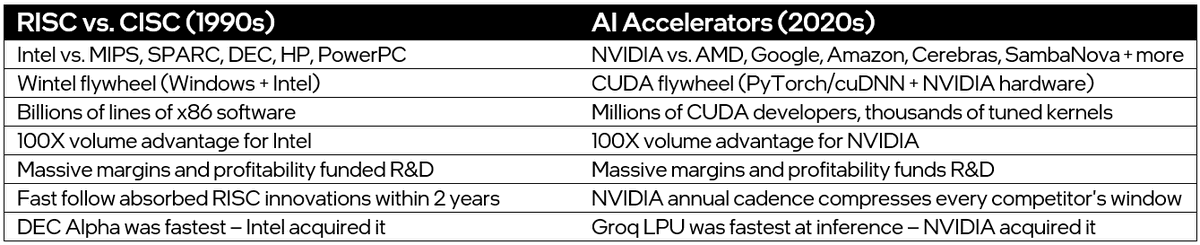
In both eras, a roster of challengers brought genuine technical innovation – and faced the same ecosystem gravity. Three decades ago, DEC Alpha was faster than Pentium. SPARC was more open. PowerPC had Apple, IBM, and Motorola. Collectively, the RISC coalition assembled more engineering talent than Intel could muster. And yet, none of it mattered. Today, Google’s TPUs offer superior price-performance for qualifying workloads. Amazon’s Trainium offers substantial cost advantages. Cerebras eliminates the inter-chip communication bottleneck that dominates GPU cluster scaling. Tenstorrent is betting that open, customizable, general-purpose silicon will eventually win. Collectively, these and other challengers represent a formidable coalition. But so did the RISC vendors three decades earlier.
Steeper Headwinds: A More Uphill Battle Today
Today’s challengers face additional headwinds the RISC vendors did not:
Higher switching costs: Porting a compiled application from SPARC to x86 in the 1990s was laborious but well-understood. Re-qualifying an AI training pipeline on alternative hardware involves validating numerical stability, convergence behavior, throughput, and distributed scaling – a process measured in multi-year engineering cycles for frontier models and costing hundreds of millions of dollars.
A fast-moving incumbent sets the pace: Intel in the 1990s was a fast follower – it quickly adopted and subsumed RISC architectural innovations. Today, NVIDIA is not a follower, it is in fact setting the pace. Each architecture generation delivers massive leaps, and the Groq acquisition shows NVIDIA will absorb external innovations rather than wait to replicate them. Jensen Huang’s relentless cadence is today’s incarnation of Andy Grove’s paranoid mindset.
A more extreme margin advantage: NVIDIAs gross margins today are higher and on a much larger revenue basis, than Intel’s margins even at the peak of the PC era. This generates enormous cash for R&D, foundry wafer allocation priority and strategic acquisitions – like the $20 billion Groq deal; at a pace no competitor can match.
A fragmented coalition: The RISC vendors at least competed in the same market. Today’s challengers are split between hyperscaler-captive chips (TPU, Trainium, Maia, all available only within their respective clouds), merchant silicon (e.g. AMD), and startups (e.g. Cerebras, SambaNova, Tenstorrent and others) with limited distribution. Google and Amazon are not trying to defeat NVIDIA in the open market – they are trying to reduce their own bills. This fragments the anti-NVIDIA coalition. No single challenger has yet been able to achieve the critical mass of developer adoption needed to displace CUDA.
The Ghosts Whisper: No Moat is Permanent
And yet. The ghosts of DEC and Sun whisper a different lesson: no moat is permanent, and the threats that disrupt incumbents almost always come from outside the existing competitive frame.
Intel did not lose to a RISC architecture. It lost relevance in mobile because Arm, a low-power design Intel dismissed for years, became the foundation of the smartphone revolution. By the time Intel recognized the importance of mobile computing, the window had closed. The Wintel flywheel, optimized for desktops and servers, simply did not apply to phones. DEC did not lose to Sun or Intel. DEC lost to itself – to organizational paralysis, to the inability to cannibalize profitable products before competitors did it for them. VAX 9000 was DEC’s attempt to defend its cash cow. It consumed a billion dollars and produced nothing. Meanwhile, the world moved first to workstations and then PCs. Sun did not lose to HP or IBM. The platform shifted beneath it. The pattern is consistent: incumbents are rarely defeated by direct competitors playing the same game. They are defeated by platform shifts that change the game entirely.
Path One: Consolidating Dominance
In one scenario, NVIDIA could consolidate dominance for a generation. The mechanism is the same flywheel that powered Intel through the 1990s and 2000s.
The CUDA ecosystem continues to compound. Challengers continue to produce technically interesting hardware that never achieves the critical software mass needed to displace CUDA for mainstream workloads. AMDs ROCm narrows the gap but never closes it – just as AMD competed on performance in x86 but never displaced Intel from the center of the ecosystem. Google and Amazon reduce their own NVIDIA dependence but remain captive to their clouds, fragmenting the anti-NVIDIA coalition. Few of the startups building accelerators continue to serve niches; just as SGI, DEC, and Sun served niches with technically superior hardware while Intel captured the volume market.
Compiler abstraction layers like Triton and MLIR chip away at the edges but never achieve parity for production workloads – echoing OpenCL, which was technically adequate and positioned as an open alternative to CUDA, but failed to overcome the CUDA ecosystem gravity.
The moat may eventually extend through open standards rather than against them.
The Groq acquisition becomes the template. When a challenger develops genuinely threatening technology, NVIDIA could simply absorb it – just as Intel absorbed Alpha’s innovations and DECs engineering talent. The Vera Rubin platform, with its seven distinct chip types including Groq-derived inference accelerators, demonstrates that NVIDIA can incorporate non-GPU architectures into its ecosystem rather than compete with them. Each acquisition deepens the moat. Market share stabilizes – below the peak, but enough to sustain the flywheel. The CUDA era lasts until a platform shift renders it irrelevant. No one can yet identify what that shift might be.
Path Two: Increasing Commoditization
In another scenario, NVIDIAs dominance peaks and gradually erodes through horizontalization – the same force that destroyed proprietary Unix. Sun was challenged not by a single competitor, but by the convergence of two commoditizing forces – x86 achieving performance parity at a fraction of the cost, and Linux providing a Unix-like OS on commodity hardware. Together, they commoditized both the hardware and the software that Sun charged premium prices for. The AI equivalent could unfold along four axes:
Compiler abstraction succeeds where OpenCL failed: Perhaps, Triton and MLIR could achieve genuine portability across hardware backends. Unlike OpenCL – which relied on hand-written kernels always slower on NVIDIA, Triton generates optimized code through compiler intelligence, narrowing the gap to single-digit percentages – compiler-based portability rather than kernel-level portability. Triton can be the “Linux” of this analogy; an open layer that commoditizes the software stack above the hardware.
Large customers break the ecosystem from within: Leading hyperscalers and frontier model developers shift a substantial portion of AI compute to custom silicon. These customers are highly incentivized to switch to alternative solutions. They don’t need to win the merchant market – just reduce their own purchases. These moves would echo enterprises moving from $500,000 Sun servers to $5,000 Linux boxes. The premium market hollows out as the largest buyers find cheaper alternatives. As the largest and most widely deployed workloads begin to switch to alternative hardware, they also drive developer mindshare away from NVIDIA.
Inference commoditizes: Training remains NVIDIA’s stronghold. But inference, which accounts for the majority of production AI spending as models move from research to deployment – fragments. Challengers to NVIDIA capture niche segments where NVIDIA’s general-purpose GPUs are overbuilt and overpriced.
A platform shift emerges: Just as power efficiency in mobile computing made raw performance on x86 less important – phones needed ARM’s energy efficiency, not Intel’s backward compatibility – a shift from centralized cloud AI to edge AI, embodied AI, or a fundamentally new model architecture creates a computing surface where CUDA may have no incumbent advantage. This might be neuromorphic computing, state-space models that don’t map well to GPU architectures, or quantum-classical hybrid systems. The history of computing suggests the shift will come from a direction no one is currently watching.
In this scenario, CUDA becomes one of several viable stacks. And NVIDIA remains profitable, albeit with compressed margins and AI computing becomes more heterogeneous than it is today.
Summary
The RISC-CISC wars teach a clear lesson: technical superiority does not determine market outcomes. Ecosystem lock-in, volume economics, and compounding incumbency do. By that logic, NVIDIA’s position looks nearly impregnable. But the past also teaches a subtler lesson: the threat that disrupts the incumbent usually comes from outside the existing competitive frame. The question today is not “which competitor has better hardware?”. The more important question is: “what platform shift makes the CUDA moat irrelevant?”
It might be compiler layers that make hardware interchangeable. Edge AI where efficiency outweighs peak FLOPS. A post-transformer architecture that doesn’t map to GPU compute. Or something no one has yet imagined. It may appear in the early years of the inference era, or it might not arrive for a decade – in which case NVIDIA’s dominance will continue to compound, and the challengers will fade into footnotes alongside MIPS, SPARC, PA-RISC, and DEC Alpha.
Finally, the role of leadership cannot be overlooked. Jensen Huang today embodies NVIDIA at the height of the AI era, just as Andy Grove once embodied Intel at the height of the PC era. Intel’s decline became apparent only after the founding generation of Intel leaders had stepped down. So long as Jensen is at the helm, NVIDIA is unlikely to skip a beat.
The semiconductor industry’s most reliable law is that every dominant architecture looks permanent until a platform shift renders it obsolete. History suggests two things with equal confidence – that the incumbent’s advantage is real and will persist longer than critics expect – and that it is not permanent.
Looking forward to an analysis of the TSMC IP ecosystem moat and what it takes to break that.
Was the strategic steps of AMD, two years ago, to focus on inference and make ROCm open source similar to when it went to 64 bit and Intel had to follow them by implementing the AMD64 ISO, although they named in differently? It seems to have got Nvidia to scramble and make strategic investments to focus more on inference, as that is where the bulk of investment is heading.